
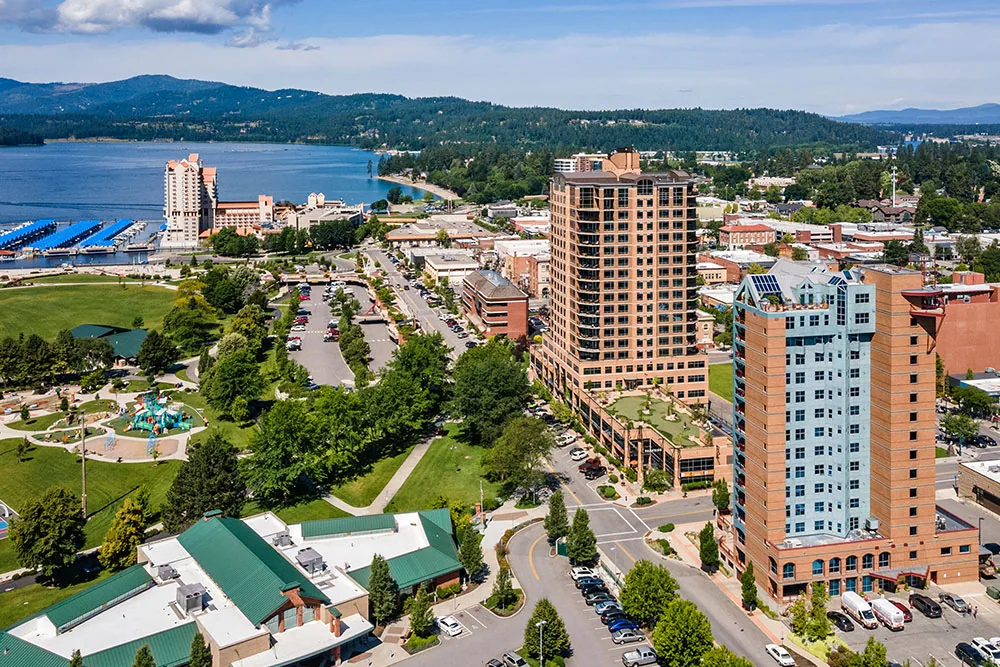
Needles and leaves clog more roofs than snow does, and in Hayden Lake, ID any building that stands close to trees has that problem. The town had 649 residents in 2020 and sits at about 2,280 feet around the lake it is named for, a lake formed by the Missoula Floods 12,000 to 15,000 years ago. A town that small, around a lake, is a place where we expect small commercial roofs, and what we check first is the setting: a roof near mature trees spends the fall collecting debris and the winter holding it under snow.
Our pricing reference is the nearby Coeur d'Alene sheet, and a roof under trees runs into its snow design, its severe weathering rating and its ice barrier rule all at once. Debris at a drain turns a thaw into a pond. Shade keeps snow on a slope for days after the sun clears the open roofs nearby. Our bids for Hayden Lake start with the drains and the shaded slopes, and the membrane comes second.
The Call: Drains and Gutters First
A roof under trees needs a drain plan before it needs a new membrane. Strainers fill with needles and leaves, gutters pack with debris and freeze solid, and valleys hold wet litter that rots the covering from above. We walk the roof in the fall, clear what has built up and photograph each drain before and after. That record tells the owner whether the problem is a failing roof or a clogged one.
When the trees are the cause, the cure is often not a new roof. It is a cover over the gutters, a larger drain strainer, an overflow scupper beside each interior drain, and a twice-yearly cleaning on the calendar. Those items cost a fraction of a replacement and often extend the roof by years. Where the roof is already past saving, the same items go into the new design. The Hayden Lake Country Club opened Idaho's first 18-hole golf course in 1912, and the grounds around a course or a lakeshore are the kind of setting where fall debris is certain. An owner of a building near the water or a landscaped property should assume the debris is coming, and the question is whether the drains are ready for it.
What It Costs: Access, Debris and Small Mobilizations
A small commercial roof in a wooded setting costs more per square than an open-lot roof, and the reasons are specific. Access can be tight, with narrow drives and trees limiting where a lift can stand. Debris adds cleanup labor before and after. Material has to be carried farther when a truck cannot reach the wall. And the fixed costs of mobilization are spread over a modest area.
We list each of these as its own line. Access and staging go on one. Debris cleanup goes on another. Tree trimming, where branches overhang the roof, is the owner's call and the owner's contractor, but we say which limbs we would cut and why: a branch over a roof scrapes the membrane in wind and drops needles all year. Seeing the lines side by side lets an owner trim the cost where a trim is cheaper than a tear-off. A cut limb costs less than the needle cleanup it saves every year, and it gives the membrane a few more summers. We would rather see an owner spend on the tree than on a membrane that the tree will wear out.
Where It Fails First: Shaded Slopes and Frozen Valleys
The north side of a shaded roof stays cold, and snow that falls there stays. Meltwater from the sunny side runs down, reaches the cold eave and freezes into a ridge of ice. Water backs up behind the ridge and finds the first lap or fastener. That is an ice dam, and the City design sheet calls for ice barrier underlayment because of it.
Valleys are the second failure point. A valley collects snow from two slopes and debris from the trees, and the melt concentrates there. Flat sections over entries and additions are the third, since drains clog and water ponds. We check each in that order. A building with a clean valley, clear drains and an intact barrier at the eave is usually in good shape, whatever the age of the covering. We also look at the attic or the ceiling space for frost on the underside of the deck, since warm air leaking upward is what melts the snow in the first place. Sealing that leak is often cheaper than any change to the roof covering, and it ends the cycle at its source.
What the Weather Does: Cold Swings and Heavy Wet Snow
A roof around Hayden Lake rides a temperature swing much like the one a few miles south, where Coeur d'Alene runs between a January near 31 F and a July near 70 F, and the covering has to stretch and recover each year. Seams and sealants take the strain.
Snow adds weight. Wet snow can double the weight of the same depth of dry snow. A roof that looks lightly loaded can already be near its limit. We tell owners to call before they climb up with a shovel, and when a ceiling shows sagging or a door starts to bind, that is the moment to call.
Alternates: What the Owner Can Add
A Hayden Lake owner typically chooses from this list:
- Gutter guards or a covered gutter system
- Larger drain strainers and overflow scuppers
- Ice barrier along eaves and in valleys
- Snow guards above a door or a walkway
- A reflective or protective coating over a sound roof
- A spring and fall cleaning visit
The cleaning visit and the overflow scuppers are the pair that keep a wooded roof alive. Gutter guards help but do not replace a visit, because fine needles pass through some guards and settle in the trough below. We say which guard style suits the debris on the site before the owner buys one, since a guard that suits pine needles may clog on maple leaves. We recommend them for every building under trees, whatever else the owner decides.
Closeout: A Roof Record and a Cleaning Calendar
The owner receives a roof plan, photos of the drains and valleys, and a cleaning calendar with the dates that matter. Preventive roof maintenance follows that calendar, and a roof drains and scuppers upgrade is the first purchase most wooded roofs need. A building that outlives its covering moves to commercial roof replacement. Hayden and Coeur d'Alene share the climate, and a lodging building gets the guest-aware phasing of a hotel roof.
Commercial Roofing Questions
Can tree debris really ruin a roof?
It holds water at drains and in valleys, which softens seams and rots the covering. Cleaning on a schedule prevents most.
Do you trim trees?
No, but we tell the owner which limbs overhang the roof and why they matter. A tree service handles the cutting.
What is an ice dam and how do I stop one?
It is a ridge of ice at the cold eave that backs meltwater under the roof. Ice barrier underlayment, ventilation and clear gutters control it.
How often should gutters be cleaned under trees?
Twice a year, after leaf drop and after spring pollen and needle fall.
Is a coating a good idea on a shaded roof?
Only if the membrane is sound and dry. Moss and algae need cleaning first, and the coating is chosen to resist them.