
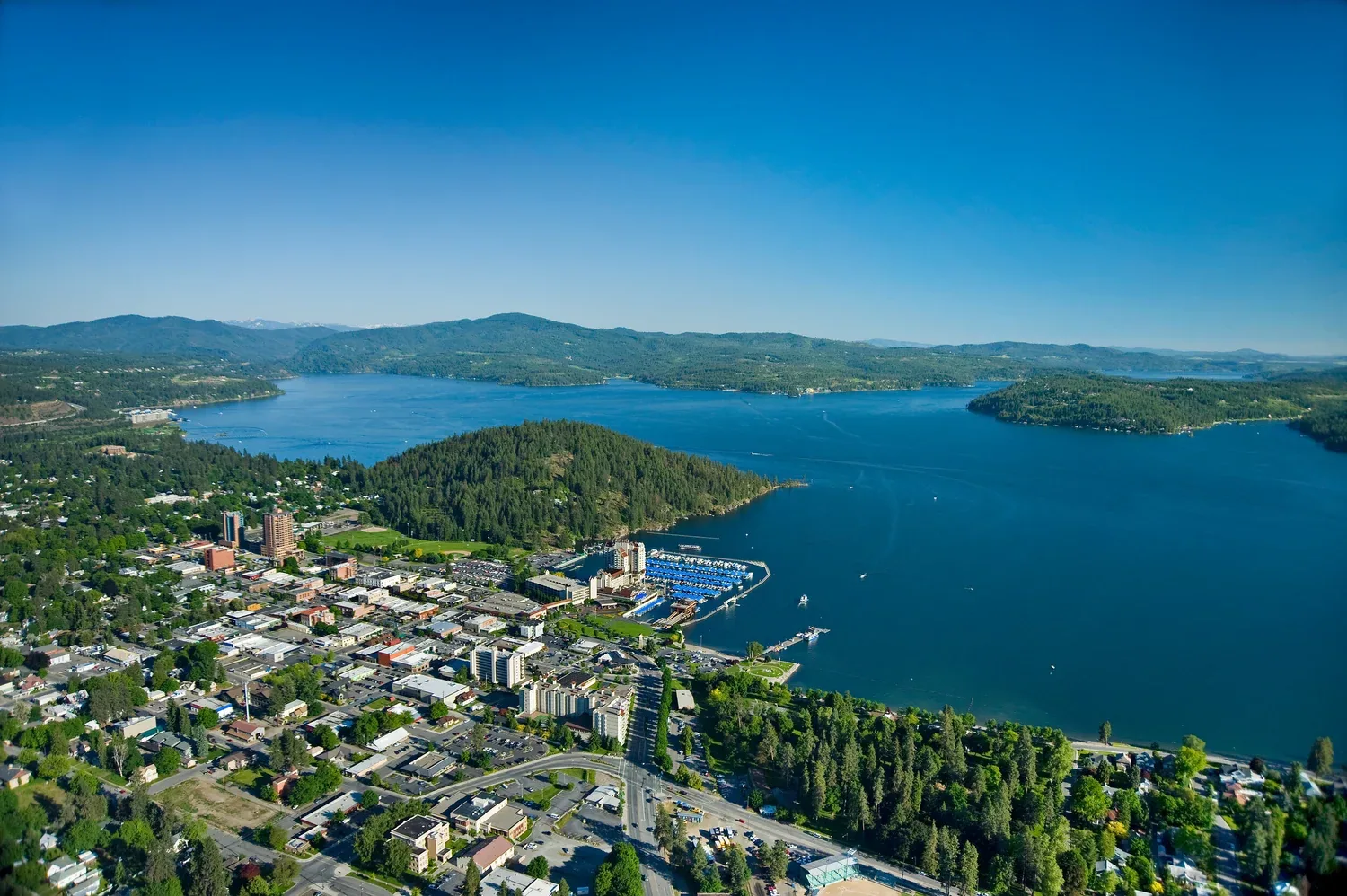
Downtown roof work has a calendar problem before it has a roofing problem. Sherman Avenue is the main commercial street, the Ironman finish is on it, and events such as Art on the Green, the Street Fair and Taste of Coeur d'Alene draw about 60,000 combined visitors a year. A crane that needs a lane closed, a dumpster that needs a curb and a crew that needs a stair all collide with that calendar. In Coeur d'Alene, ID the cost of a downtown roof is often set by when the street is free.
We schedule around the events, price the staging as a line and tell the owner which weeks are off the table.
What We Look For: The Buildings Downtown Supports
Downtown holds commercial buildings along Sherman Avenue, civic buildings such as the Coeur d'Alene Public Library, and hospitality tied to the Coeur d'Alene Resort and its lakeside tourism. The age, structure and roof type of any given building are things we read on the roof, not from the street. We walk it and write down what we find.
On a first walk we look at how the roof drains, how the parapets are flashed, where rooftop equipment sits, how the roof is reached and what sits below the work area. Those answers matter more than the address, and they decide the repair, recover or replacement choice.
One more point for the GC: downtown sites have little laydown space. Material comes just in time, goes up the same day and is installed before dark. A schedule that assumes a yard is a schedule that slips, so we write the delivery windows into the plan and confirm them with the supplier.
Staging: Cranes, Dumpsters and Street Closures
On a busy commercial street, material has to arrive at the roof some other way than a loading dock. Options are a crane or a lift in the street, a hoist at the back of the building, an alley delivery or a roof-to-roof route. Each has a permit, a cost and a time window. A lane closure for a crane lift usually lasts hours, and the permit needs lead time.
We price the staging plan as its own line, with the permit, the traffic control and the lift. Debris comes down a chute into a covered container placed where it blocks nothing. If the plan needs the street on an event weekend, we say so early, and we move the lift. A quiet weekday outside the event season is the cheapest day for a crane, and we offer it first.
Access to the roof is the other half. A tall downtown building may offer an interior stair, an exterior ladder or only a hatch. Where the only way up is through a tenant space, we schedule the climb with the tenant and protect the floor. Fall protection is set up before the first boot is on the roof, and the plan is written in the bid.
What the City Sheet Says
Every downtown roof submittal is checked against the city's published sheet, and its snow, wind and ice barrier lines each have a downtown consequence. Snow load matters downtown because parapets and neighboring buildings make drift pockets, and meltwater needs a path out. Ice barrier matters at eaves and low-slope edges, where a refreeze backs water under flashing.
A roof with a drift of wet snow behind a parapet can carry a heavy local load. We locate drains and scuppers before pricing and add drain capacity where a pocket forms. Edge metal and parapet caps get fastened to the wind number.
Winter downtown is a different job from summer. Sidewalks ice, parapets shed snow onto pedestrians, and a lift in the street competes with plows. Snow guards or a parapet cap that sheds away from the walk are worth pricing wherever snow can fall onto an entrance. We check the roof edge above every door on the first walk and list what falls where.
Moisture is the other winter story. A flat roof behind a parapet holds meltwater when a scupper freezes, and the water finds the flashing. Scuppers and drains get the first look, because a roof that drains in January is a roof that holds in March.
What It Costs: Options and Lines
The roof work itself prices like any commercial job. Repair is the cheapest, coating extends a sound roof, a recover adds a layer over a dry roof, and replacement starts over. Downtown adds three lines: staging and permits, off-hours labor when the owner wants noise limited to certain hours and protection for the sidewalk and entries.
We show those lines apart from the roofing lines so the owner sees what the location costs. Wet insulation found at tear-off is a change-order trigger with a unit price already written in, and a scan beforehand shrinks the odds of a surprise.
Insulation and drains are where a downtown roof surprises people, so we scan before we price. An infrared survey maps wet board, and a few core cuts confirm it. The result goes into the bid as a base number plus a unit price for anything we miss.
Visitors, Holiday Lights and Roof Attachments
The Coeur d'Alene Resort's Holiday Light Show, which uses over 1.5 million bulbs, shows how much seasonal display a downtown can carry. Seasonal lighting, banners and signage are often attached to roofs and parapets, and each attachment is a penetration. We look for them on a walk, check how they were flashed and note any that have loosened. Removing a fixture without sealing the hole leaves a leak behind.
For owners who put up seasonal fixtures every year, we recommend a standing detail: a curb or a plate that stays on the roof, flashed once, with the fixture bolting to it. It costs once and saves a repair every spring.
Hospitality roofs deserve their own plan. A building that houses guests has quiet hours, ice-melt rules and laundry or kitchen exhaust on the roof, and the repair has to respect all three. Work is sequenced by section, closed each day and timed around check-out and the weekend rush. If a leak opens over a guest room, an emergency crew responds around the clock and the permanent repair follows on the next stable day.
Nearby: Riverstone, Post Falls and Beyond
Downtown sits inside Coeur d'Alene, and the commercial districts nearby, such as Riverstone along Northwest Boulevard, follow the same city sheet. Further out, Post Falls and Hayden have their own building mixes. A single roof program can cover them all, with one walk calendar and one record.
The record travels. A downtown roof walked in October has photographs, a drain map and a repair list that the next visit builds on, so each season starts from what the last one found.
Commercial Roofing Questions
Can roof work happen during Art on the Green?
Quiet roof-top work can, but staging cannot. We move cranes and dumpsters to dates the street is free.
Who pulls the street permit?
We prepare it and the owner or GC signs, depending on the job. We build lead time into the schedule.
Do older downtown roofs need a different spec?
They need a walk first. We do not assume age or structure. Cores and a deck check decide.
How do you protect the sidewalk?
Covered walkways, barricades and a spotter where the lift swings over foot traffic.
Can you work nights?
Yes, where noise rules allow, at a premium. We price it as a separate line.