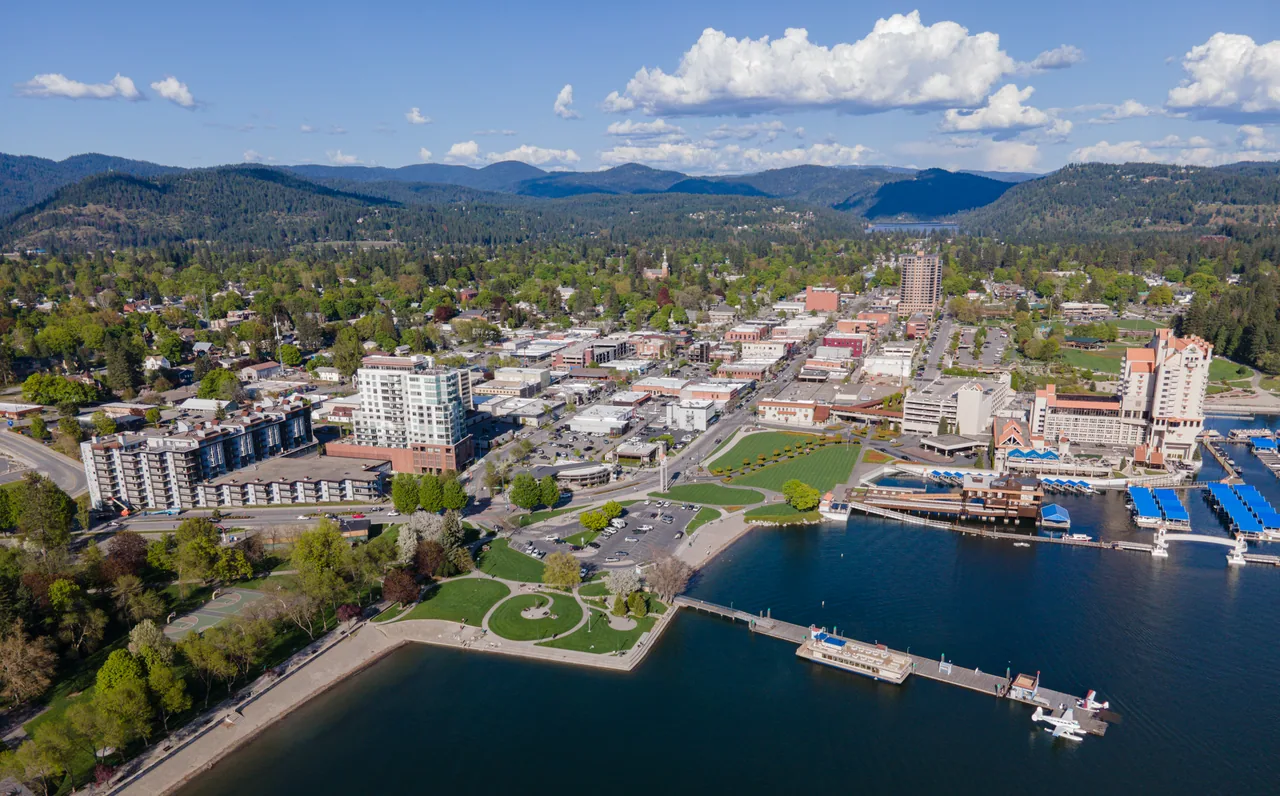
The Rathdrum Prairie is the flat ground that commercial roof design in this region is measured against. About 2,274 feet up, the prairie floor holds Coeur d'Alene, Post Falls, Hayden, Rathdrum, State Line and Huetter, and I-90 crosses it. Prairie bids are measured against the Coeur d'Alene sheet's numbers: 60 psf of snow, 115 mph of wind and an ice barrier rule.
We price the prairie by the line. The base scope, the snow and wind items and the alternates each sit on their own line, and the owner or GC decides what stays in.
The Call: Big Flat Roofs and Few Obstacles
On a prairie a roofer should expect a lot of low-slope work. Tilt-up warehouses and flex space at Riverbend Commerce Park in Post Falls. Aviation and light industrial buildings in Hayden, where Empire Airlines and Rocky Mountain Construction are headquartered. Retail clusters along Northwest Boulevard, with the Village at Riverstone. Manufacturing in Post Falls, where Buck Knives employs about 320 people. Medical and school roofs in between.
Each building type has its own call, but the prairie adds a common thread. Open ground gives the wind a long run and puts the snow into drifts. Wide roofs, parapets that hold drifts and many rooftop units are common on this ground. The call is the same three-way choice, with the prairie's emphasis: drains, edges and drift pockets first. We walk, core and write the call with prices.
Each end of the prairie has its own mix. Toward Coeur d'Alene, the roofs are retail, office, medical and institutional, with parapets, interior drains and tenant improvements. In Post Falls, they are tilt-up warehouses and manufacturing, with wide fields and many rooftop units. In Hayden, they are aviation and light industrial, with hangar-style spans and shop roofs. In Rathdrum, a fast-growing city, they are new commercial space, with the BNSF line, originally Northern Pacific, running through town. A single method works across all of them because the failure points repeat. The walk starts at the drains and the drift pockets, moves to the edges and the penetrations, and ends with the seams, and the same checklist that finds a clogged strainer on a Post Falls warehouse finds one on a Rathdrum retail roof. What changes from building to building is the consequence of a leak, and the consequence sets the order in which the work gets done. A roof over a clinic waiting room goes ahead of a roof over a tool crib, even when the tool crib roof looks worse from the parking lot, and the file records why the order was chosen.
What It Costs: Area, Layers and the Snow Premium
Prairie roofs are large, and large roofs are priced by the square foot with a few lines that scale differently. Tear-off and disposal scale with layers. Insulation scales with thickness and taper. Edge metal and flashing scale with perimeter and penetrations. And a snow premium covers the heavier edge attachment, more drain capacity and snow guards where the 60 psf design calls for them.
The biggest lever on a large roof is whether it can be recovered or restored. A roof recover on a dry roof saves tear-off, and a coating restoration on a sound one saves more. Neither works on wet insulation, and cores decide. Owners with several large roofs can pool bids, and the multi-site roof program puts them on one schedule with one unit sheet.
What the Code Sheet Says: The Standard for the Prairie
Coeur d'Alene's Building Services publishes the adopted criteria that submittals in the city are checked against, with snow, wind, frost and Seismic Design Category C values under the statewide 2018 codes.
The snow-and-cold regime that drives commercial roof design here shows in Post Falls, at about 59 inches a year. With water content running from about 1 percent to 33 percent, one depth of snow can weigh very different amounts. Other cities on the prairie adopt their own criteria, and we confirm the governing numbers for each site at permit.
Where It Fails First: Drift Pockets, Drains and Edges
On a prairie roof, the first failures are in the same three places. Drift pockets behind parapets and rooftop units, where snow piles deep and melts slowly. Drains, which clog with grit and freeze in cold snaps. And edges, which take the wind. A windstorm like the one on November 17, 2015 is the reminder that perimeter fastening gets tested.
We check them in that order. Drift pockets go on a plan with measurements. Drains go through the roof drain and scupper scope. Edges go through edge metal, coping and gutters. Across the prairie, Post Falls, Hayden and Rathdrum share the same pattern, and a visit often covers several. The aquifer beneath the prairie is a reason to keep fuel, oil and cleaning waste off roofs and out of drains; where a roof carries equipment that uses them, we check the pans and the drip lines and note any staining at the drains.
Alternates and Growth: Roofs Along a Busy Corridor
I-90 carried about 60,729 vehicles a day at Huetter in 2017, and the state expects roughly 137,000 a day between SH-41 and northwest Coeur d'Alene by 2045, while SH-41 ties the prairie's growth areas together from Post Falls to Rathdrum. Growth along those corridors means new commercial roofs, and new roofs have early-life details to check. A first-year walk, with the roof still under the contractor's warranty, is cheap and finds the misplaced fastener or the unsealed curb while it is early in the roof's life and the fix is small.
Alternates for prairie roofs are easy to price. Snow guards above entries. A cover board under a membrane where technicians walk. Tapered insulation to cure a pond. A larger scupper with heat cable. A taller curb to clear a drift. A heavier edge with a stronger cleat. Each is a line with a price. The owner can take one, take all or defer, and the file records the decision. Alternates are most useful when they are chosen by building use: snow guards where customers walk, a cover board where technicians walk, and overflow scuppers wherever a parapet surrounds the roof and a clogged drain would have nowhere to send the water. A decision to defer carries a date, so the item comes back up on the next walk instead of vanishing. Our condition reports give a new owner the baseline.
Schedule and Snow Window: Late Spring Through Early Fall
Material temperature limits hold the practical season to late spring through early fall. The prairie's contractors all want the same months, so booking early matters. A calendar note in August beats a phone call in October.
The sequence that works is a condition report in the fall, a budget decision over the winter, bids in early spring and construction from late spring. Maintenance visits each fall and spring keep the repair list short, and emergency calls are answered around the clock when a storm opens a roof.
Commercial Roofing Questions
Which code applies on the prairie?
Each city sets its own criteria within Idaho's statewide 2018 International Building Code. We price from the Coeur d'Alene sheet and confirm at permit.
Is a recover possible on a large flat roof?
Where the old insulation is dry and the roof flat and sound, and cores confirm it.
What fails first on a prairie roof?
Drift pockets, drains and edges.
Can several roofs share a bid?
Yes. Pooled bids lower unit prices and keep one specification.
When should I book?
Walk in the fall and bid in early spring.