Wet insulation is invisible and heavy. It sits under a membrane that looks fine, holds water against the deck and quietly eats the roof from below. A moisture survey finds it. We scan the roof with an infrared camera at the right time of day, confirm the hot and cold areas with cores and moisture meters, and mark the wet areas on a map. That map decides whether you patch, recover or tear off. It also gives a general contractor a firm quantity to bid against.
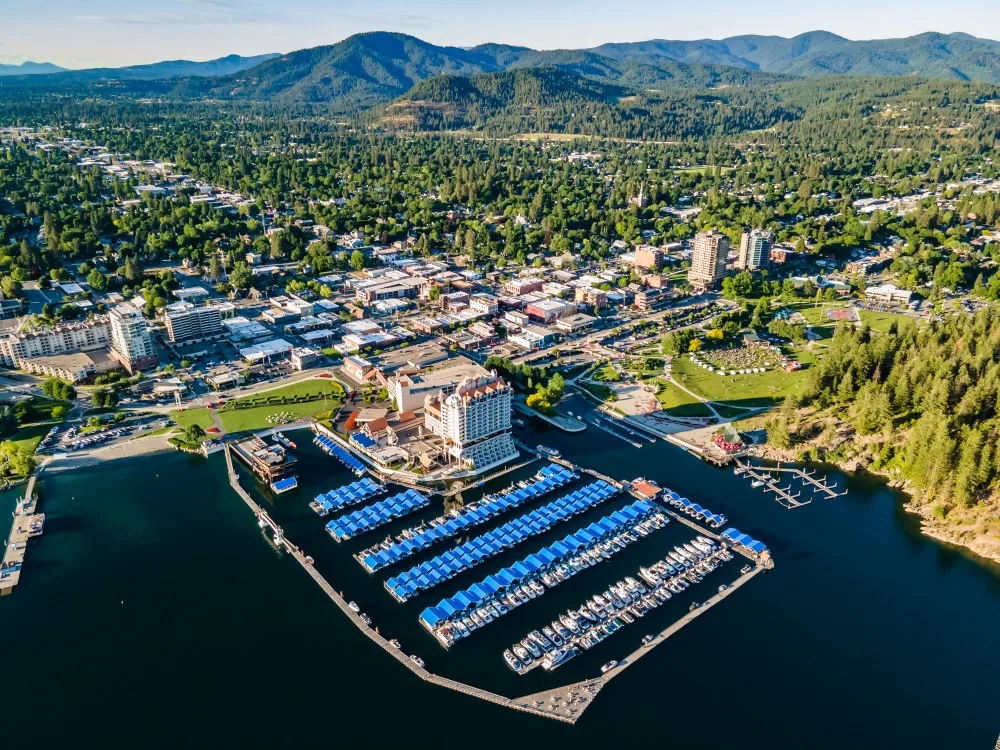
In Coeur d'Alene, ID, where snow loads reach a 60 psf ground design value on the city sheet and meltwater works at every weak point, wet insulation can build up quietly for years. Surveying early costs far less than discovering the problem during a tear-off, when the quantity of wet board turns into a change order.
How the Scan Works: Heat Storage and Release
Dry insulation heats and cools quickly. Wet insulation holds heat longer. After a sunny day, the sun warms the whole roof. As evening falls, dry areas cool fast, and wet areas stay warmer for longer. An infrared camera sees that difference as a pattern of warm patches on a cooling roof.
That is why scans run at dusk or in the early evening, on roofs that have been in sun all day, in dry weather. We do the walk-through scan, mark the warm areas with paint or flags, and then verify them. A thermal image alone is not proof. It is a map that tells us where to cut.
Verification: Cores and Meters
Every anomaly we mark gets checked. We cut a small core, look at the layers and test the insulation with a moisture meter. Wet insulation feels heavy, looks stained and sometimes drips. We note the insulation type, thickness, deck material and any trapped moisture in the adhesive or the cover board.
Cores also catch false positives. A warm patch can come from a thicker section, a mechanical unit's heat, or a different insulation type. Without cores, the map would send us after the wrong areas. With cores, the boundary of the wet zone is a line we can defend to an owner, an insurer or a lender. Every opening gets closed before we leave, with materials that match the roof. The patch locations go on the map, so a later crew knows where the roof was already opened and does not read a patch as a defect or a repair that failed.
Why Snow Country Roofs Get Wet
Post Falls, a few miles west of Coeur d'Alene, averages about 59 inches of snow a year. On a flat roof that snow melts at midday and refreezes at night. Each cycle pushes water into any open seam, cracked flashing or failed sealant. Over a few winters, small entries add up to wet insulation.
The weight matters too. Soaked snow is heavy, and wet insulation under that load loses compressive strength, and a soft spot can turn into a ponding area, which turns into a bigger leak. We look for these chains of cause and effect, because stopping the first link is cheaper than fixing the third.
The Decision: Repair, Recover or Replace
The map turns a vague worry into numbers. If wet areas cover a small share of the roof and sit near known leaks, we cut and replace those sections and repair the details. If wet areas are widespread, a roof recover is off the table, because insulation that is wet today will not dry under a new layer.
When the survey shows too much wet material, a full replacement makes more sense, and we can show the owner the exact area that drives the price. The survey also supports a due diligence survey during a sale, because it quantifies a hidden liability.
Buildings: Where We Scan Most Often
Large, low-slope roofs gain the most. A tilt-up building in Riverbend Commerce Park, built as a multi-tenant warehouse, is a typical candidate for a full-roof scan because a single survey covers a lot of area quickly. Healthcare buildings, such as Kootenai Health with its 329 beds, benefit from knowing exactly where a roof holds moisture before water reaches an occupied floor.
Cold storage, food plants and other buildings with high interior humidity are tougher. Interior vapor can condense under the roof, so we scan and core with that in mind and look at vapor retarders as well as membranes. On warehouse roofs and hospital roofs alike, the map is the first document the repair scope is built from.
Conditions: When We Can Scan
A good scan needs a dry roof with no snow, no standing water and a sunny day before the scan. Wind and clouds reduce contrast. That narrows the window in Coeur d'Alene, and late spring through early fall gives the best conditions. Winter scans are rarely reliable, so we use that season for planning and schedule the survey for the first dry stretch.
Roofs with gravel, heavy coatings or ballast hold heat in ways that hide anomalies. In those cases, we lean more on cores and meters, and we say how much confidence each method carries. Flying the roof first with a drone helps in planning where to scan; Coeur d'Alene Airport, about nine miles northwest of downtown, is one of the airspace checks we make before a flight.
The Report: A Map You Can Hand to Anyone
The deliverable is a roof plan with the wet areas shaded, each core location numbered and a table that lists what each core showed: layers, thickness, moisture reading and condition. Photographs sit beside the plan. A summary gives the wet area as a share of the roof, which is the number that drives the repair-or-replace conversation.
We also note dry areas worth keeping. If the insulation is dry across most of a roof and wet only near three drains, the owner can fix those drains and preserve the rest. That is a smaller bill than a replacement, and the planned repair that follows is scoped from the map instead of from guesses.
Commercial Roofing Questions
Can infrared find a leak by itself?
It finds wet insulation, which usually sits near a leak, but it does not identify the entry point. We use the map to guide the leak trace, then confirm with a probe or water test. The map plus the trace gives the full picture.
How accurate is the map?
Cores tie the scan to reality. Where the thermal pattern and the core agree, the boundary is solid. Where they disagree, we add cores until they do. The report says which areas are confirmed and which are inferred.
Does a new roof need a survey?
A baseline scan a year or two after installation gives a clean reference. If a leak appears later, the map shows what changed. It is a modest cost compared with a dispute over when the moisture started.
What if the roof has a coating or gravel?
Scans are harder but not impossible. We adjust timing, rely more on cores and meters, and state our confidence level for each area in the report.
How long does the work take?
The scan runs in an evening. Coring and patching take a day. The mapped report follows within a few days of the scan.
Can you scan roofs outside Kootenai County?
Yes, across North Idaho and the Spokane area. The method works wherever the roof is low-slope and the weather gives a dry, sunny day ahead of the scan.